


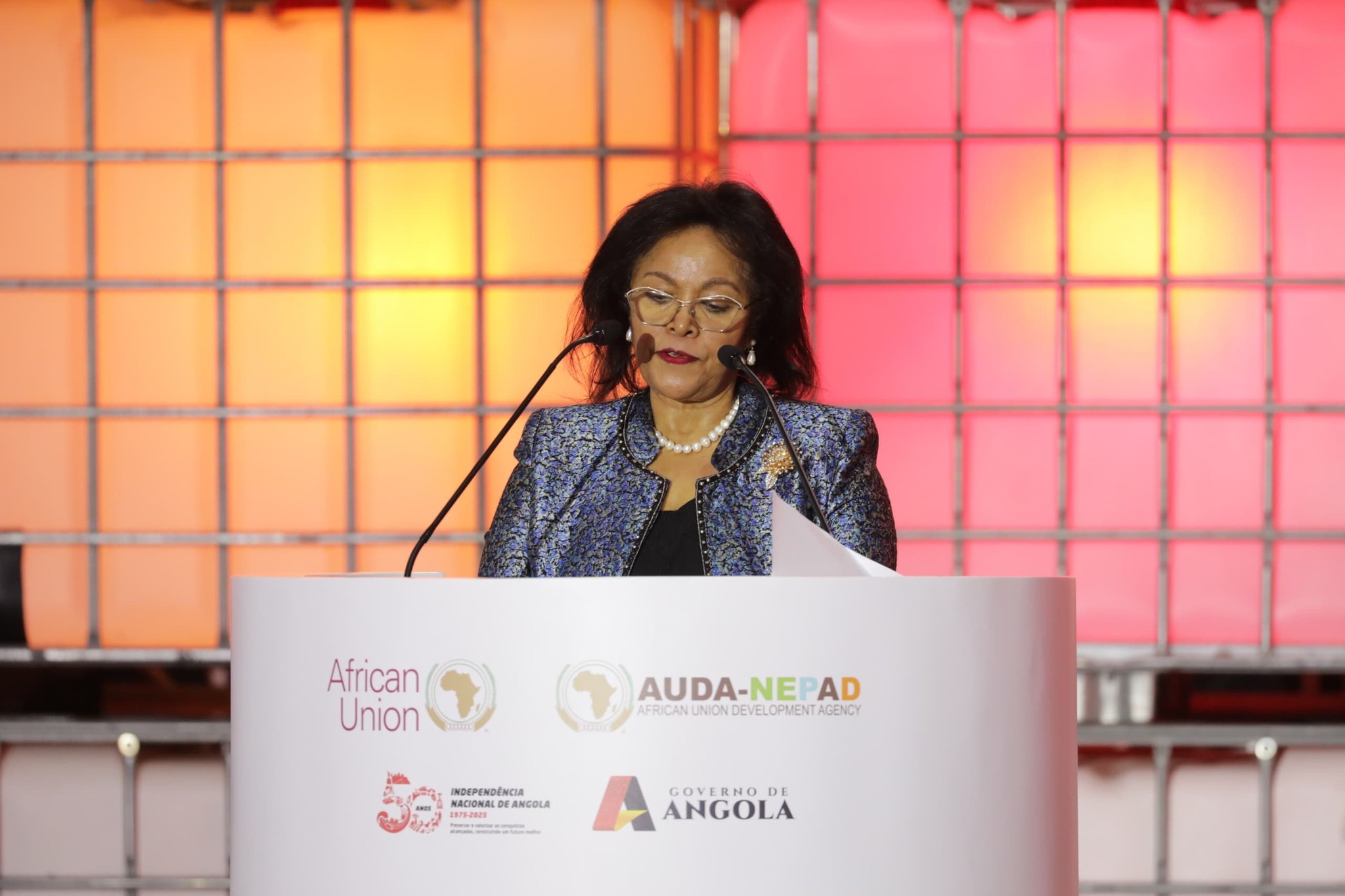


SPEECH BY
MRS. NARDOS BEKELE-THOMAS
CHIEF EXECUTIVE OFFICER, AFRICAN UNION DEVELOPMENT AGENCY – NEPAD (AUDA-NEPAD)
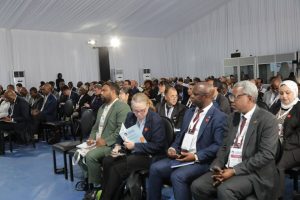
LUANDA SUMMIT ON FINANCING INFRASTRUCTURE IN AFRICA
Luanda, Republic of Angola – October 2025
Your Excellency João Manuel Gonçalves Lourenço, President of the Republic of Angola and Chairperson of the African Union;
Your Excellency Azali Assoumani, President of the Union of Comoros;
Your Excellency Faure Essozimna Gnassingbé, President of the Council of Ministers, Head of Government of the Togolese Republic;
Your Excellency Mahmoud Ali Youssouf, Chairperson of the African Union Commission (AUC);
Your Excellency Sifi Ghrieb, Prime Minister, Representing the President of Algeria;
Your Excellency Nestor Ntahontuye, Prime Minister, Representing the President of Burundi;
Your Excellency Lieutenant General Kamel El Wazir, Deputy Prime Minister of the Egypt;
Your Excellency Mahamadou Issoufou, African Union Champion of AfCFA, Former President of Niger;
Your Excellency Olusegun Obasanjo, Former President of Nigeria;
Honourable Ministers of Foreign Affairs, Finance and Planning, Infrastructure, Commerce and Trade;
Excellencies, Governors and CEOs of our continental financial institutions; partners from the private sector; distinguished colleagues and friends
On behalf of the African Union Development Agency, it is a great honour to address this vital gathering, bringing together the custodians of Africa’s infrastructure agenda: the project owners, the implementers, the financiers, and our private investors.
Allow me first to express our profound gratitude to His Excellency President João Lourenço, and to the Government and people of the Republic of Angola for hosting us.
We are meeting in a country that is not just discussing connectivity; it is building it.
Angola has granted a 30-year concession for the Lobito Corridor, with over $500 million committed and long-term financing in the pipeline, to move not just raw minerals, but finished African value.
(BRIEF PAUSE FOR APPLAUSE)
We are here because infrastructure financing is no longer optional—it is existential.
Our continent’s infrastructure deficit is a massive economic drain. It costs us up to two percentage points in annual GDP growth and reduces productivity by as much as 40%.
Practically, this means:
- Nearly half our continent still lacks electricity. Africa now represents more than 80% of the world’s population left in the dark.
- Intra-African trade is stuck at just 15 to 18 percent, hobbled by structural barriers that make it prohibitively expensive to trade with each other.
- Our logistics costs are almost double global norms, consuming 20% or more of operating cost in some sectors.
- Visa barriers are slowing business, limiting talent, and killing opportunity. Free movement must be the norm. An African passport must mean mobility across Africa—this continent should be visa-free for Africans.
(BRIEF PAUSE FOR APPLAUSE)
Our purpose over the coming days is unequivocal: We must accelerate the shift from diagnosis to delivery—from merely identifying gaps to actively closing them.
The moment demands we transform political will into practical action and elevate our continental vision into concrete, measurable investments.
This is not a starting point, but a critical acceleration of the progress we have already begun.
At the Dakar Financing Summit two years ago, we identified 22 strategic regional PIDA projects valued at approximately $52 billion. And since then, several projects have moved from talk to traction:
- The Lesotho Highlands Water Project (Phase II) secured $168 million.
- The Luapula Hydropower Project advanced with a $4.2 million grant for project preparation.
- The ZiZaBoNa interconnector locked in project preparation funding to integrate the Southern African Power Pool.
- The Standard Gauge Railway toward Eastern DRC moved forward with nearly $700 million in new approved financing.
- The Abidjan–Lagos Corridor has registered commitments of $15.6 billion in investor interest.
- We made a huge progress on the Trans-Saharan Highway.
And we have built instruments, not just projects. The Alliance for Green Infrastructure in Africa (AGIA), created with Africa50, the African Development Bank and AU partners, reached a first close of $118 million.
Its mandate is specific: fund early-stage preparation and de-risk climate-resilient infrastructure so projects move faster to bankability and can unlock billions in long-term green capital.
Excellencies, we must recognize these gains. They prove something fundamental:
When Africa is clear, capital moves. When Africa is structured, partners come. When Africa owns delivery, projects advance.
But progress is not the same as transformation. And the gap between the two is exactly why we are in Luanda.
After Dakar, our review was clear:
- Finance is still fragmented. We are competing against ourselves for the same pools of capital, project by project.
- Politics and procedures slow us down. Too many priority projects depend on temporary goodwill. When leadership changes or national interests clash, the continental corridor stops.
- Capacity is uneven. If one country on a corridor cannot move, the entire corridor is bottlenecked. We must make national capacity continental capacity.
- The cost of inaction is unbearable. The cost of not interconnecting our power grids is paid by factories that never open. The cost of not completing transport corridors is paid in higher food prices and lost regional trade.
The lesson from Dakar is clear: we can no longer treat financing as a fragmented marketplace of scattered deals.
We must transform it into a unified strategy—where Member States strategically fund our DFIs, and our DFIs, in turn, channel that capital into priority, bankable projects.
We must commit to supporting our DFIs by giving them the necessary scale and by ensuring that our DFIs are granted preferred credit status.
Together with the Alliance of African Multilateral Financial Institutions (AAMFI) and our continental partners, we are advancing a project financing facility. It will be launched with an initial envelope of $1.5 billion, out of which $100 million to be dedicated to project preparation. Its purpose is focused: structuring and closing deals on high-impact, cross-border infrastructure.
Furthermore, as we design the long-term funding mechanism, we must implement the 5% agenda for all Member States.
The objective is simple: African capital must first serve African connectivity, African energy security, and African productive capacity.
(BRIEF PAUSE FOR APPLAUSE)
Because one lesson from Dakar is that if we do not build our own blended instruments, someone else will define our risk, price our assets, and dictate our timelines.
That era must end.
The second lesson is institutional. We need an apolitical governance body for continental infrastructure
We need an autonomous delivery authority for priority PIDA corridors—a body that is technically grounded, treaty-backed, and insulated from day-to-day political shifts.
An authority that can enforce agreed standards, monitor milestones, and escalate bottlenecks directly to Heads of State and Governments.
Without such an instrument, the very projects that are supposed to bind Africa together are the first to be delayed, diluted, or quietly abandoned.
This is where Luanda becomes more than a report card. Luanda must mark a structural shift in how we govern, prepare, and finance Africa’s connectivity.
By the end of this Summit, we must leave with three things:
- Deals that will close: Signed, structured, financeable transactions for strategic cross-border assets.
- A Governance Commitment: That priority PIDA corridors are treated as continental assets, protected by binding agreements, and overseen by a dedicated delivery authority with real accountability.
- Unified Capital: A clear commitment that the entire African financial system—public, sovereign, and private—will act in unison to fund Africa’s integration, with a dedicated financing window for project preparation.
If we deliver these three outcomes, then Luanda will not be « another summit. »
That is our responsibility to our Member States. That is our responsibility to our young people. That is our responsibility to the continent we are building.
Therefore we invite you to join us in our deal rooms, boardrooms and workshops to make a difference.
Joseph Kapo ,Envoyé spécial à Luanda-Source AUDA-NEPAD